Rolling vs Folding Clothes: What Actually Saves Space

You've watched the videos. Roll your clothes, they said, and your carry-on will swallow twice as much. Then you rolled a dress shirt, packed it, and pulled out a fabric accordion at the other end. Rolling isn't wrong. It's just not the whole answer, and treating it like a universal rule is exactly why half the advice out there fails on the one item you actually cared about.

The Rule Everyone Repeats, Half Right
Rolling does compress better than a flat fold, most of the time. Soft fabric bends around a roll without a hard crease line, and a rolled stack takes less vertical space than the same stack folded flat. That part of the internet is correct. What gets left out is that the advantage depends entirely on what the fabric does when you bend it, and stiff fabric does not bend the way cotton does. Roll a blazer and the fibers along the roll's tightest curve get compressed into a permanent line. Fold it along its own seams instead, and there's no curve fighting the structure.
Soft Fabrics: Rolling Wins, No Asterisk
For t-shirts, underwear, socks, swimwear, and most knitwear, roll and don't look back. These fabrics have loft and give, so a tight roll squeezes out trapped air the same way a compression cube does, just with your hands instead of a zipper. You also get fewer sharp crease lines than a flat fold produces, because the fold is a gradual curve instead of one hard bend. If most of your bag is casual travel clothing, rolling alone can free up real room, and it pairs well with compression cubes, since the fabrics that compress well when rolled are the same ones that compress well under a second zipper.
Structured Fabrics: Where Folding Wins, With a Catch
Dress shirts, suits, structured trousers, and anything with a sewn-in shape behave differently. These fabrics resist bending, so a roll fights the fabric's own structure and produces a crease exactly where the resistance was highest. Folding along the garment's natural seams avoids that fight entirely, because you're bending where the fabric was designed to bend. The catch is that a flat fold alone doesn't compress much; it just avoids new wrinkles. The fix experienced packers use is folding combined with a soft layer between each fold, a rolled t-shirt or a thin scarf laid inside the fold line, which stops the fabric from creasing against itself and adds almost no bulk. Folded and interleaved this way, a stack of dress shirts can end up flatter than the same shirts rolled, while coming out with fewer wrinkles.
The Experiment: Same Pile, Two Methods
Take the exact same five-day wardrobe, say four t-shirts, two pairs of jeans, a light sweater, and one button-down shirt. Pack it once rolling everything, once folding everything, using the same suitcase and no cubes either time. The rolled version wins on the t-shirts and sweater; they compress into a noticeably smaller block, and you can see daylight around them where a fold would have left flat, stacked edges. The jeans come out close to even, since denim rolls without much penalty. The button-down is where the two piles diverge hardest: rolled, it's wrinkled enough to need an iron on arrival. Folded along its seams, it comes out nearly flat. Run this with your own wardrobe once and you'll stop trusting either method as a blanket rule.
The Third Option: Bundle Wrapping
For the one item that has to look sharp the moment you land, a blazer, a dress, anything you can't afford to wrinkle, there's a third method that beats both rolling and folding: bundle wrapping. You build a soft core, then wrap your structured pieces around it in layers instead of creasing them at all. It takes longer to pack and you lose easy access to any single item without unwrapping the bundle, so it's not for your whole suitcase. Our full suitcase-packing guide walks through the technique step by step if you've got one or two pieces that need it.
The Hybrid Most Experienced Packers Actually Use
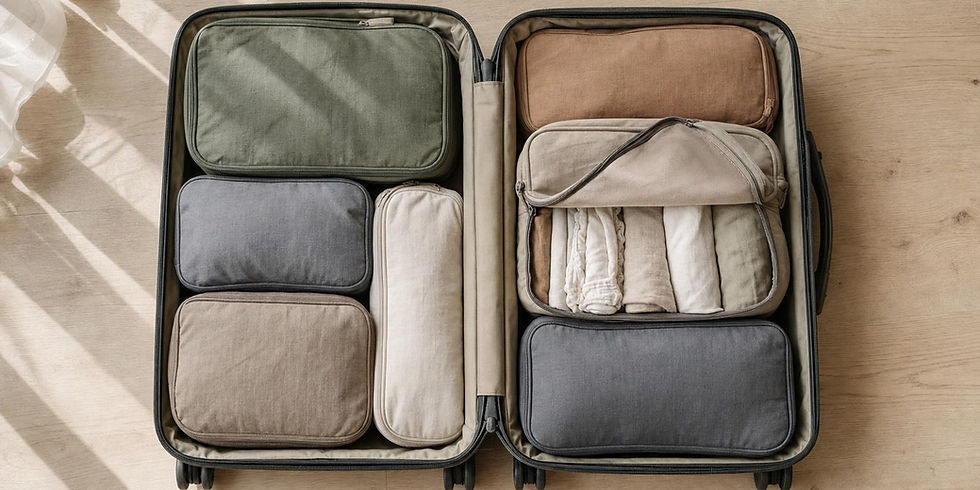
Nobody who packs for a living picks one method and applies it to everything. The pattern that holds up trip after trip: roll the soft, casual layer, fold the structured pieces with something soft between each layer, and bundle-wrap the one item you can't afford to wrinkle. Sort your pile by fabric before you sort it by outfit, and the packing method almost picks itself. Once you organize the rolled layer into packing cubes, the whole system holds together instead of shifting into a mess by the second flight.
Stop asking which method wins. Ask what each item in your pile is made of, then pack accordingly. That single habit saves more space and more wrinkles than committing hard to either side of the debate.


Comments