How to Pack a Suitcase, Layer by Layer

You've folded everything neatly, laid it all on the bed like a store display, and the zipper still won't close. That's not a packing failure, it's a sequencing failure. A suitcase isn't a bag you drop things into. It's a structure, and the order you build it in decides whether it closes flat or fights you at the airport.

The Bottom Layer Carries the Weight
Whatever sits at the bottom, near the wheels when the case is upright, needs to be heavy, rigid, and unbothered by pressure. Shoes go here, soles facing the case wall so treads don't touch clothes, stuffed with rolled socks or a charger cable to use the dead space inside them. Toiletry bags, adapters, and anything in a hard shell belong in this layer too. Putting weight low keeps the case stable when it's standing and stops rigid objects from denting soft items packed above them. One heel-to-toe pair on each side, rather than shoes stacked flat, saves real width.
The Middle Layer: Rolling Beats Folding, Except When It Doesn't
This is where most packing advice stops at "roll, don't fold," and that's only half true. Rolling wins for cotton t-shirts, knitwear, and anything with stretch, because the fibers flex around the roll instead of creasing. Folding wins for stiff fabrics: dress shirts, suits, structured trousers, anything with a sharp seam. Roll a blazer and you get a hard crease line exactly where the fabric couldn't bend. Fold it along its natural seams instead, and it comes out flatter than a tight roll ever would. The rule that actually holds up: soft and casual gets rolled, structured and formal gets folded. Mixing both in the same case, by fabric rather than by habit, beats committing to one method for everything, a point covered in more depth in our full packing list breakdown.
Bundle Wrapping for the One Item You Can't Wrinkle
If you're carrying a blazer, dress, or anything that has to look presentable the moment you land, bundle wrapping beats both rolling and folding. Start with a soft core, a packing cube of socks or a toiletry pouch works fine. Lay your longest items, pants or a dress, flat and horizontal, alternating which side the waistband sits on so the bulk distributes evenly. Lay tops on next, vertical, alternating direction the same way, until you've built a crisscross stack around the core. Then wrap each layer around the core in sequence, starting from the outside in, smoothing wrinkles as you tighten each wrap. The finished bundle has almost no fold lines because nothing gets pressed into a single crease; the tension of the wrap does the work instead. The tradeoff is access: you can't easily pull out one shirt without unwrapping the whole bundle, so this technique is for the one or two items you need pressed and ready, not the whole suitcase.
Compression Cubes: Where the Squeeze Actually Pays Off
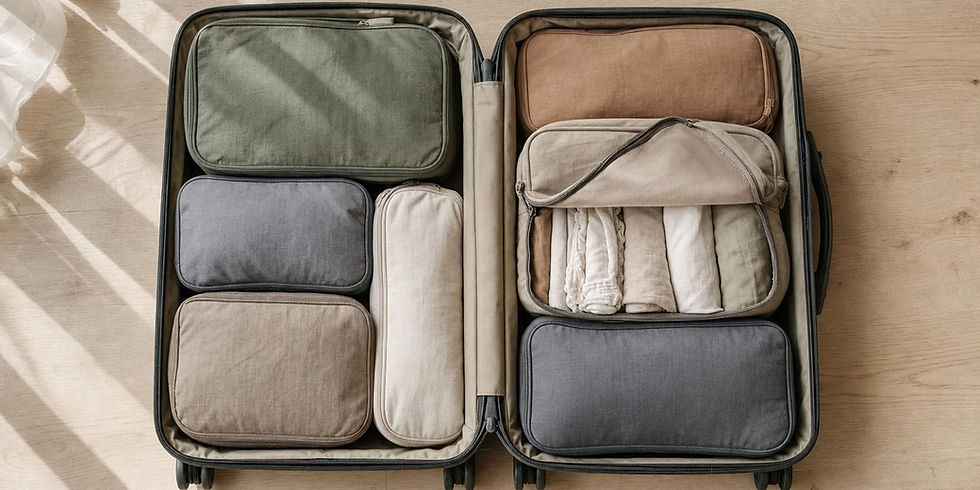
Compression cubes work on a two-zip system: one zipper closes the cube, a second one presses down and forces out the trapped air. That works well on t-shirts, underwear, and knitwear, the same fabrics that compress well when rolled. It does almost nothing for a stiff denim jacket or a packable down coat, which resist compression by design. Pack cubes in this order: fill them with your rolled middle-layer items, zip the seal, then zip the compressor last, right before it goes in the case. Compressing too early lets the contents relax back out while you keep packing. For a deeper walkthrough of sizing and stacking cubes by category, see how to actually use packing cubes.
Top Layer: Pack What You'll Touch First
The top layer is prime real estate for anything you need without digging: a rain jacket, a change of clothes for a delayed connection, the charger you'll want at security. Fragile items go here too, cushioned by soft clothing rather than resting against the hard shell. This is also where a lot of travelers waste space by tossing in loose items instead of one more small bundle or a flat zip pouch, a habit that's worth breaking, as we cover in our broader packing tips.
Weight Distribution That Survives the Gate Scale
Many international carriers cap carry-on weight around 7 to 10 kilograms, even when US domestic carriers rarely weigh a bag at the gate. Keep your heaviest items low and centered rather than pressed against one side wall; an unevenly loaded case feels heavier when an agent lifts it by the handle, and that impression matters as much as the actual number. If you're right at the limit, wear your heaviest jacket or boots onto the plane instead of packing them. That alone can shave a kilogram or two off a bag that's borderline.
When the Case Won't Close
Don't sit on it. That just compresses the top layer unevenly and stresses the zipper track, which is how zippers actually fail mid-trip. Open it back up and check for a dome in the middle rather than a flat surface; that's usually one bulky item, often a shoe or a jacket, sitting where it's fighting the lid instead of nesting into the layers. Move that one item into worn clothing, a bundle wrap, or a compression cube, then repack the top layer flat before you try the zipper again. If the case still won't close after that, the honest fix is fewer things, not more force.
Pack heavy and rigid at the bottom, sort your middle layer by fabric instead of habit, save bundle wrapping for the one item that has to look sharp, and check for a dome before you fight the zipper. Get that sequence right once and it becomes automatic on every trip after.


Comments