Packing Cubes: How to Actually Use Them

Somebody gifts you a set of packing cubes. You stuff your clothes into them, zip them shut, and wonder what the fuss was about. Your suitcase looks tidier, sure, but you still dig through three cubes to find one pair of socks. That is not a cube problem. That is a system problem, and it is fixable in one packing session.
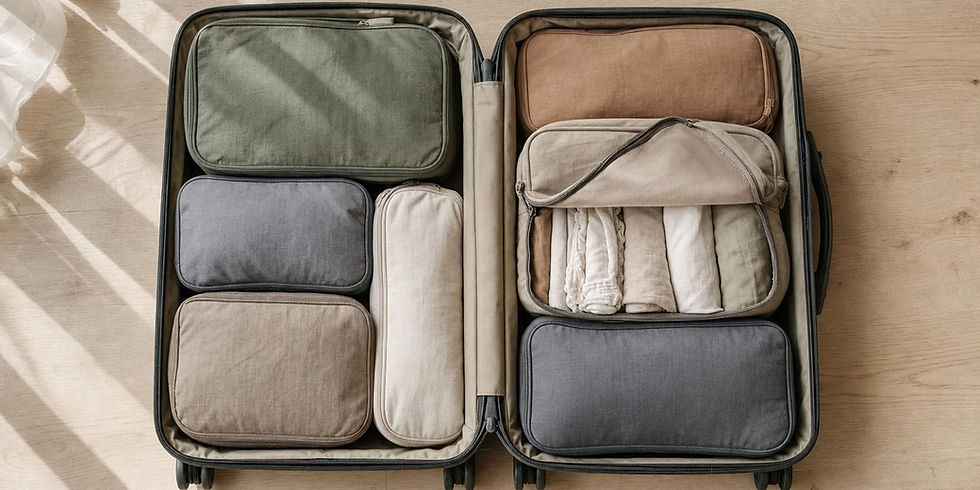
Why most people get packing cubes wrong
The common mistake is treating cubes as small suitcases: fill each one until it closes, in whatever order the clothes come off the pile. You end up with the same chaos as before, just divided into zippered portions. Now the sock you need might be in any of four bags instead of one.
Cubes are not containers. They are labels you can hold. The moment a cube stops meaning something specific, it stops helping you.
What is the right system for packing cubes?
Give every cube exactly one job, and never mix jobs. Two systems work, and which one fits you depends on the trip.
One cube per category. Tops in one, bottoms in another, underwear and socks in a small one. This is the default for most trips. When you need a shirt, you pull one cube and ignore the rest. It also makes repacking on the last morning almost automatic: everything has a home, and an empty home is easy to spot.
One cube per day or outfit. For short trips with fixed plans, think a wedding weekend or a three-city work trip, pack complete outfits together: shirt, bottoms, underwear, socks in one cube per day. Each morning you grab one cube and get dressed without thinking. In our experience this shines on trips where you change hotels a lot and never fully unpack.
Pick one system per trip and commit. Mixing them is how you end up back at the sock hunt. Several more tricks in this spirit are in our packing hacks for a weekend getaway.
Do compression cubes actually save space?
Yes, with a caveat. Compression cubes have a second zipper that squeezes the air out after you close the first one. With soft, medium-bulk clothing, t-shirts, hoodies, jeans, they genuinely shrink the pile by a noticeable margin. A week of clothes that barely fit a carry-on suddenly leaves room for shoes.
The caveat: compression saves volume, not weight. The airline scale does not care how clever the zippers are. If your problem is a weight limit, compression will not rescue you.
If you fly with carry-on only and keep losing the space battle, a set of compression packing cubes (paid link) is one of the few travel accessories that does what the box promises. Regular cubes organize. Compression cubes organize and shrink.
Use cubes as hotel drawers
Here is the part nobody mentions in product photos: cubes keep working after you land. Instead of unpacking into a hotel dresser of questionable cleanliness, lift the cubes out and set them on a shelf or straight into the drawer. Open the tops-cube like a drawer, take what you need, done.
You never really unpack, so you can never really forget anything in the room. On checkout morning, packing means stacking four cubes back into the suitcase. Five minutes, including the zip.
Keep one cube for dirty laundry
Bring one cube empty, or empty one on day one, and declare it the dirty laundry cube. Worn clothes go in there and nowhere else. This solves two problems at once: your clean clothes stay clean, and the day-eight question of "is this shirt still wearable?" answers itself by location.
Bonus at home: you carry one cube straight to the washing machine and the trip is officially over. A darker color or a mesh top helps you never confuse it with the clean ones.
A cube inside your carry-on
Small cubes work as dividers inside bags that have no structure of their own, especially backpacks and under-seat bags. One slim cube with cables and chargers, one with in-flight comfort items, and your personal item stops being a black hole. We break down what belongs in that bag in what to pack in your personal item.
When packing cubes are pointless
Honest limits, because cubes are not a religion.
You travel very light. If your whole wardrobe for the trip is five items in a small backpack, cubes add weight, bulk and zippers for nothing. One-bag minimalists usually do better with a single pouch for underwear and calling it a day.
Bulky winter gear. A ski jacket or thick fleece does not fold small enough to gain anything from a cube; it just fights the zipper. Wear the bulkiest layer on the plane and let the puffy things fill the natural gaps in the suitcase instead.
Structured bags with good dividers. If your suitcase already has straps and panels that work, cubes just duplicate them.
Which sizes do you need?
Skip the ten-piece megasets. Most travelers need three or four cubes: one large (bottoms, sweaters), one or two medium (tops), one small (underwear and socks). The cubes should tile the bottom of your suitcase roughly edge to edge; a cube that slides around is a cube that unpacks itself in transit. Buy for the bag you actually fly with, not the biggest bag you own.
Roll or fold inside the cube?
Roll casual clothes: t-shirts, underwear, leggings. Rolls pack tight, wrinkle little and let you see every item from above when you open the cube. Fold the wrinkle-prone stuff: dress shirts, blazers, anything with a collar, in flat, cube-width folds. In a compression cube, fold rather than roll; flat layers compress evenly, rolls fight back.
Before your next trip, decide the job of each cube before a single shirt goes in, and keep one empty for laundry. The full what-goes-in-the-bag question is a separate topic, and The Ultimate Packing List covers it. The cubes just make sure you can find all of it later.
As an Amazon Associate, ThingsToPack earns from qualifying purchases made through some links in this article.


Comments