How to Pack for Two Weeks in a Carry-On

Fourteen days, one carry-on, no checked bag. On paper it sounds like a math problem you cannot win: double the days, same box you used for a weekend. It is not a bigger version of a one-week bag, and treating it that way is exactly why so many people give up and check a bag on day three of the trip.

The Outfit Math Changes at Two Weeks
For a week, you can almost get away with packing enough clothes to avoid laundry entirely. At two weeks, that math breaks down fast. Nine or ten clothing items covered one week's mix-and-match combinations with room to spare. Doubling that to eighteen or twenty items does not fit in a carry-on, and even if it did, you would be carrying weight you barely use.
The real number for two weeks sits closer to twelve or fourteen pieces, not twenty. Five or six tops, three or four bottoms, one layer for temperature swings. That gives you dozens of combinations through repetition and color coordination, not through owning more clothes. The piece that makes this work is a laundry reset around day seven, roughly the trip's midpoint. You are not packing for fourteen days of unique outfits. You are packing for seven days, twice, with one wash in between.
Shoes stay capped at two or three pairs regardless of trip length: one for walking, one for evenings, sandals only if the climate demands them. A fourth pair almost never earns its volume, even on a two-week trip where you might argue you need the variety. Wear the bulkiest pair on the plane both ways.
Build a Real Laundry Rotation, Not a Backup Plan
On a one-week trip, laundry is optional insurance. On two weeks in a carry-on, it is the strategy itself, not a fallback if something goes wrong. Plan for it before you leave, the same way you plan flights and hotels.
Hotel laundry service is the easiest option when it exists, but it is usually priced per item and adds up fast on a mid-range budget. Ask at check-in whether the hotel offers a flat-rate bag instead of per-piece pricing; many business and long-stay hotels do, and it changes the math completely.
Sink washing handles underwear, socks, and one or two shirts overnight. Pack a few sheets of laundry detergent, they weigh nothing and do not count as a liquid. Roll wet items in a towel and press out the water before hanging them; this cuts drying time by more than half compared to hanging them dripping wet.
A laundromat near your accommodation is the cheapest full-load option when your stay allows it, and it is worth planning one afternoon around, especially on trips longer than ten days where sink washing alone stops covering everything.
Timing matters more than method. Do not wait until you are down to your last clean shirt. Build the laundry stop into your itinerary around day six or seven, before the trip's second half, so a delayed hotel machine or a closed laundromat does not leave you stuck.
A rotation like this means you are never carrying more than about a week's worth of clothes at once, which is what keeps the whole plan inside a carry-on's volume.
Compression Packing Stops Being Optional
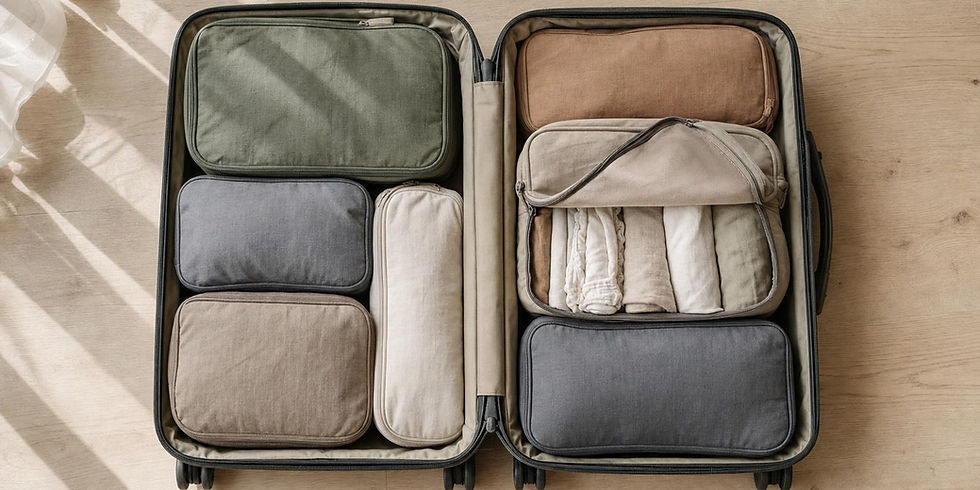
At one week's volume, compression is a nice-to-use. At two weeks, it is close to mandatory, because the math simply does not work without it. Rolling clothes instead of folding already buys back 15 to 20 percent of usable space. A set of compression packing bags squeezes air out of that rolled bundle and reclaims another meaningful chunk, often enough to be the difference between a bag that zips and one that does not.
Organize by category rather than by outfit: one bag for tops, one for bottoms, one for underwear and socks. This does two things a normal packing cube does not. It keeps clean and worn clothes physically separate once the laundry rotation starts, and it makes security checks and hotel unpacking faster, because you are never digging through the whole bag to find one item. On a two-week trip you will open these bags a dozen times or more; the organization pays for itself by day three.
The "What If I Need It" Trap
Most carry-on-only beginners overpack out of fear, not out of an actual gap in the plan. The extra sweater "just in case," the third pair of shoes "in case the first ones hurt," the backup toiletries "in case the hotel doesn't have any." None of these come from something that happened on a past trip. They come from imagining a version of the trip where nothing goes as planned and packing for that version instead of the real one.
The honest question is not "could I need this," because almost anything could theoretically be needed. The question is "have I actually run out of this on a past trip, and was it hard to solve there." Toothpaste, shampoo, and painkillers exist in every country you are likely to visit. A missing item is usually a ten-minute errand, not a crisis. Reserve real backup space for things that are genuinely hard to replace on the road: prescription medication, a specific electronics adapter, glasses if you only own one pair.
One Presentable Outfit, No Extra Volume
Two weeks is long enough that a work call, a nice dinner, or an unplanned event is likely to come up somewhere in the middle. You do not need a separate formal wardrobe for it. Pick one outfit from your regular rotation that can be dressed up: a plain shirt without wrinkles-prone fabric, dark trousers or a simple dress, and shoes that already double as your evening pair.
The trick is choosing fabric over adding pieces. A wrinkle-resistant button-down or a knit dress packs the same as your casual clothes but reads as put-together the moment you add it to an outfit you are already carrying. Skip the separate "just in case I need to look professional" blazer unless you know in advance that you will need it; it is exactly the kind of item the fear-packing trap above is built around.
Make the Bag Work Before You Fly
Lay out your full two-week plan on the bed before you pack: twelve to fourteen pieces, two or three pairs of shoes, one dressier option built from clothes you already chose. Roll and compress everything by category, and pencil in a laundry stop around day seven. If a piece does not fit into the rotation or the "have I actually needed this before" test, it does not go in the bag. If you are still deciding on the bag itself, how to choose a carry-on backpack and how to actually use packing cubes are worth reading before you start folding.
As an Amazon Associate, ThingsToPack earns from qualifying purchases made through some links in this article.


Comments