How to Pack Bulky Winter Clothes Without a Second Suitcase

You're standing over an open suitcase the night before flying home from a ski week, and the down jacket that fit fine on the way out now looks like it swallowed half your remaining space. Add snow boots, two sweaters and the gloves you barely wore, and the zipper is losing the argument. Buying a second suitcase feels like the only fix. It usually isn't.
Wear Your Bulkiest Layer Instead of Packing It
The biggest space saver isn't really a packing technique at all. Wear your heaviest jacket on travel days instead of folding it into the suitcase. A puffer that fills a third of your bag disappears completely the moment it's on your body, and no airline weighs or counts what you're wearing.
This feels absurd at a warm airport before a flight to a cold city, and you'll be tempted to skip it. Don't. Carry the jacket over your arm through security if it's too warm for the terminal, then put it back on near the gate. The same math applies to boots: your heaviest pair travels on your feet, not in your bag. One worn coat and one worn pair of boots often free up more room than every other packing trick combined.
Roll, Don't Vacuum: Compression Bags and Down
Down insulates through loft. Thousands of tiny clusters trap air, and that trapped air is what keeps you warm, not the down itself. A set of compression packing bags works by squeezing air out of the space around your clothes, not out of the clusters themselves, and that distinction matters more than most packing advice admits.
Cram a down jacket into the smallest possible sack, or sit on a vacuum bag until every bit of air hisses out, and you flatten those clusters instead of just shrinking the space between them. Down that's been crushed hard for days, especially inside a hot cargo hold, doesn't always spring back to its full loft afterward. The jacket ends up permanently a little less warm, not just wrinkled until you shake it out.
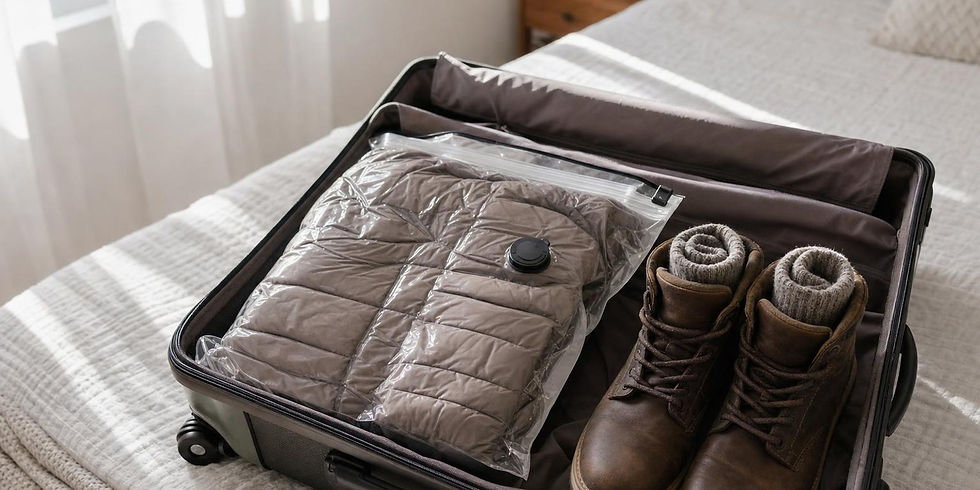
Roll the jacket loosely instead. Push it into a compression bag or a packing cube and squeeze out most of the air, not all of it, then stop before the fabric goes stiff and taut. Save the hardest compression for items with no loft to protect, like jeans, cotton sweaters and scarves. Down and synthetic-fill jackets get the gentler setting. This is the same trap covered in more depth in our general winter packing list, and it applies as much to one bulky jacket as to a full cold-weather wardrobe. Unpack it as soon as you land instead of leaving it crushed at the bottom of the bag for a week.
Boots Are the Real Space Thieves
A pair of winter boots eats more suitcase volume than almost anything else you own, mostly because most people pack them wrong. Left empty, boots hold their shape and waste the air trapped inside. Stuff each one with rolled socks, underwear, a charging cable or a bundle of gloves, and you reclaim space you were throwing away for free.
Boots also don't belong in the center of the suitcase. Lay them flat against the wheels or the back wall, sole facing out, and build your soft layers around them. Packed in the middle, boots force every other item to bend around an unmovable brick. Packed at the edge, they become part of the suitcase's structure instead of fighting it.
Thin Layers Beat One Thick One
A single heavy sweater and a single heavy coat sound efficient, but three thinner layers often pack smaller than two thick ones while keeping you just as warm. A base layer, a thin fleece and a packable shell compress flat and stack neatly, where one bulky sweater holds its shape no matter how you fold it.
This isn't only a warmth argument, it's a volume argument. Thin layers also fill the gaps around rigid items like boots and toiletry bags, so less of the suitcase is wasted air. If you're packing for one specific city rather than a general winter trip, our Vienna winter packing guide shows how that layering plays out in practice for a real destination and season.
The Trip Home Is the Harder Pack
Nobody plans for the return leg when they pack the outbound bag. You'll come home with the same bulky jacket and boots, plus whatever souvenirs, gifts or duty-free bottles you picked up on the way. The suitcase that zipped shut easily on day one rarely zips as easily on the last morning.
Plan for that before you leave, not at the hotel at six in the morning. Pack the suitcase with ten to fifteen percent of it empty on the way out, and keep whatever packing cubes or compression bags you used outbound somewhere accessible rather than buried at the bottom. Decide in advance which jacket you're willing to wear on the flight home if the zipper won't cooperate otherwise. The layer that saved you space on the way out can do the same job again.
None of this needs new gear beyond what you probably already own. Wear your heaviest layer instead of packing it, roll the down loosely instead of crushing it flat, stuff your boots and set them at the edge, and leave room for the trip home before you've even left. A second suitcase is rarely about how much winter clothing you're carrying. It's usually about how the first one got packed.
As an Amazon Associate, ThingsToPack earns from qualifying purchases made through some links in this article.


Comments