Hardside vs Softside Luggage: How to Pick the Right Shell

Your suitcase just got thrown onto a baggage cart from three feet up, twice, on two different continents. Either the shell flexed and shrugged it off, or a corner cracked and your shampoo bottle is now part of your socks. That single moment is the whole hardside versus softside argument, and almost nobody thinks about it until they're standing at the carousel staring at a dent.
What the Shell Is Actually Made Of
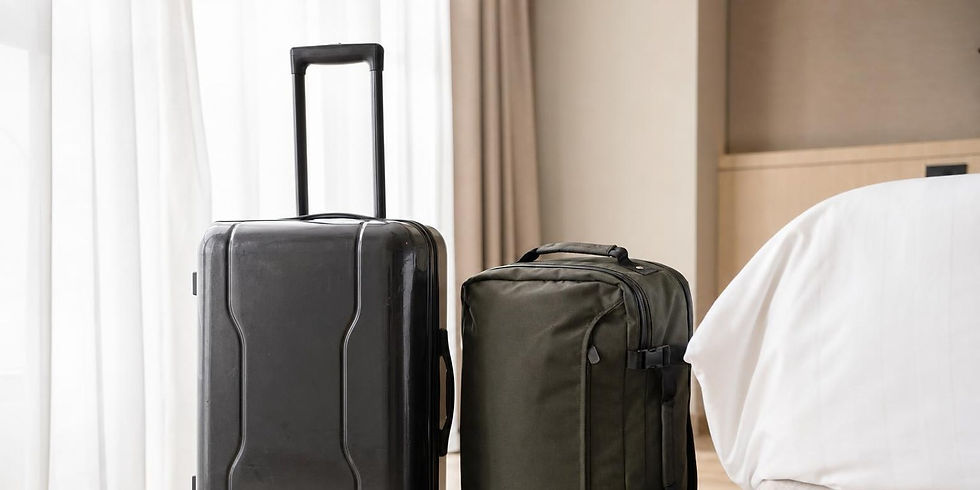
Hardside suitcases are molded plastic, and the two materials you'll run into are polycarbonate and ABS. Polycarbonate is the modern standard, and for good reason: it bends under an impact and springs back instead of cracking. Drop it, sit on it, let a conveyor belt slam it into a wall, and the shell absorbs the hit and returns to shape. ABS is the cheaper option, molded into rigid, boxy shapes that look sharp on a store shelf. It's also more brittle. Under real stress, a hard enough knock, cold weather, or a few years of use, ABS tends to hold a dent or split at a corner instead of flexing back. If you fly more than a couple of times a year, that difference adds up fast.
Softside Fabric: Nylon vs Polyester
Softside luggage skips plastic entirely for woven fabric stretched over a semi-rigid frame, usually nylon or polyester. Ballistic nylon is the toughest common option, a dense, tightly woven fabric rated in denier, a measure of thread thickness. Serious luggage runs in the 1050 to 1680 denier range and resists tearing and abrasion well, shrugging off scuffs that would scratch a hard shell. Polyester costs less and weighs less, but the weave is usually coarser and wears down faster under repeated handling. A budget polyester bag might look fine for a few trips, then fray at the seams by year two. If you're going softside, the extra money for nylon is worth it.
The Space Truth Nobody Advertises
Here's the part hardside sellers don't lead with: a rigid shell has a fixed volume. What fits, fits. What doesn't, doesn't, and there's no cheating it at the gate. Softside bags usually have an expansion zipper that adds an extra inch or two of depth, and the fabric itself gives a little when you're sitting on the lid trying to force it shut. That flexibility is a real advantage if you tend to buy things on a trip or pack for unpredictable weather. It's also a real risk if you lean on it too hard: an overstuffed softside bag strains the zipper, wheels and seams in ways a rigid shell can't. A quick read on how to pack a suitcase gets more out of a fixed hardside volume than winging it ever will.
Theft Protection, Realistically
A hard shell resists something a fabric bag can't: getting sliced open. Light-fingered handlers and airport theft go for the weak point, and on a softside bag that's the zipper seam, not the fabric itself. A sharp blade run along a zipper takes seconds and leaves the bag looking untouched from a few feet away. Integrated locks help on both types, but a hardside shell paired with a locked latch is genuinely harder to open on the move without leaving evidence. No suitcase stops someone with unsupervised time and your bag, though. Keep passports, cash and electronics on your body, whatever the shell.
Weight: The Factor Everyone Underrates
Every pound of empty suitcase is a pound you can't fill with clothes before hitting an airline's checked-bag weight limit, typically around 50 pounds (23 kg) in economy on most international carriers. Polycarbonate hardside cases run lighter than you'd expect for a rigid shell, often close to a softside nylon bag of the same size. ABS hardside cases tend to run heavier, since the material needs extra thickness to hold its shape. Softside bags, especially polyester ones, are usually the lightest option on the shelf. If you're packing close to the limit, or watching a budget airline's tight carry-on weight allowance, shave weight from the empty bag first.
Wheels Change Everything on Rough Ground
Shell material gets the attention, but wheels decide how your arm feels after a mile of cobblestones. Four-wheel spinners roll upright and glide sideways through crowded gates, which feels great on polished airport floors. On cobblestones, gravel or a cracked sidewalk, those small swiveling wheels catch and drag, and the whole bag tips. Two-wheel rollers use bigger, inset wheels you pull at an angle, and they handle rough terrain with far less drama, even if they're clumsier weaving through a security line. Most hardside carry-ons ship as spinners now. If your trips involve old-town cobblestones, look for a hardside carry-on with larger wheels instead of assuming spinner means better.
Which Shell Fits Your Trips
Skip the back-and-forth and match the bag to how you actually travel.
Pick hardside if: you check bags regularly and want rain and impact protection, you carry electronics or anything fragile, you worry about slashing in crowded transit hubs, or a fixed packing limit actually keeps you from overpacking.
Pick softside if: you routinely need that extra inch of expansion, you want exterior pockets for a passport or laptop without opening the main compartment, your trips involve rough terrain where two-wheel durability wins, or weight is your main constraint.
Pick polycarbonate over ABS if you fly more than a handful of times a year. The price difference pays for itself the first time it survives a drop that would have cracked a cheaper shell.
Read through our packing tips for your next trip once you've settled on a shell, since the right bag only helps if what goes inside it is organized too. Most trips go fine with either material. The rough ones, the delayed connection, the cobblestone old town, the overhead bin fight, are where the shell you picked actually earns its price.
As an Amazon Associate, ThingsToPack earns from qualifying purchases made through some links in this article.


Comments