Can I Use My Hair Dryer in Europe?

You unpack in a hotel in Lisbon, plug your hair dryer into a cheap plug adapter, and hit the switch. There is a pop, maybe a small spark, and a smell of hot plastic. The dryer is dead, and so is your morning routine. This happens often enough that it is one of the most common electronics mistakes US travelers make in Europe.
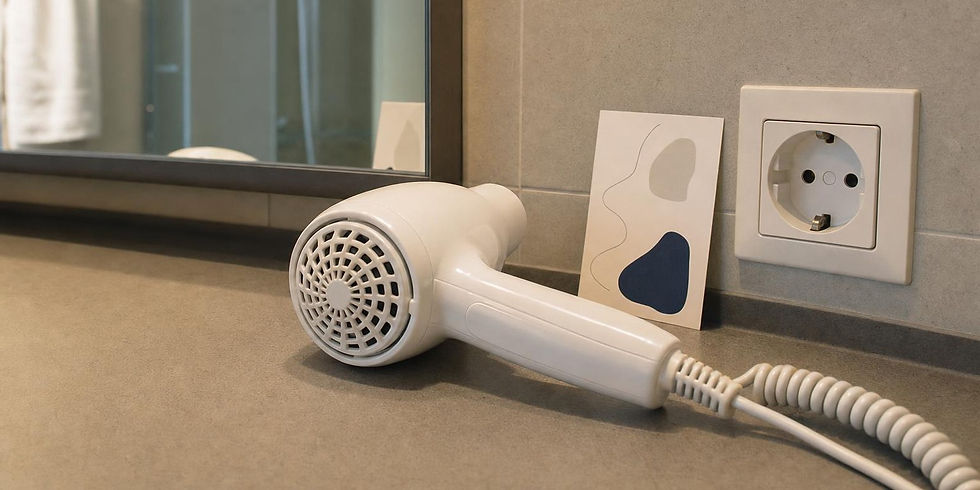
The Short Answer: Usually No
If your hair dryer is a standard US model and you only have a plug adapter, do not plug it in. Most American hair dryers are built for 120 volts, and most of Europe runs on 220 to 240 volts. A plug adapter changes the shape of the plug so it fits the socket. It does nothing to the voltage. Your dryer will get roughly double the electricity it was built for, and that rarely ends well.
This is different from your laptop charger or phone charger, which almost always says "INPUT: 100-240V" somewhere on the brick. Those are dual voltage by design. Your hair dryer, unless the box specifically says dual voltage, is not.
Why Hair Dryers Are the Problem Child
Two things make hair dryers worse than nearly every other device in your bag. First, wattage: a typical US hair dryer draws somewhere between 1200 and 2000 watts, with 1500 watts being about average for a home model. That is roughly ten times what a phone charger uses and several times what a laptop charger uses.
Second, and more important, is what is inside. A laptop or phone charger uses a switching power supply, an electronic circuit built specifically to accept a wide range of input voltages and convert it cleanly. A hair dryer's heating element is a coil of resistance wire, the same idea as a toaster. It has no logic, no regulation, nothing that adapts to different voltages. It just resists the current flowing through it and turns that resistance into heat, no matter what voltage shows up.
That distinction is worth knowing beyond hair dryers, since it applies to any device you are trying to figure out before a trip. Our guide on how to check voltage compatibility for your devices walks through reading the label on any charger or appliance before you pack it.
Adapter vs. Converter, Worked Through
A plug adapter is shape only. A voltage converter actually changes the electricity itself. People conflate the two because both are small boxes you carry in a plug pouch, and the mix-up is exactly what fries hair dryers every summer.
Here is the physics in plain terms. A heating element has a fixed resistance. Power output follows the square of the voltage, not a straight line. So a dryer built for 120 volts and rated at 1500 watts, if you feed it 230 volts through nothing but a shape adapter, does not draw a bit more power. It draws something like three to four times its rated wattage in that instant, for as long as the heating coil survives it. That is why the failure is immediate: a pop, a burning smell, sometimes visible smoke, not a slow decline.
For the fuller breakdown of when you need a shape adapter versus real voltage conversion, see our piece on the difference between a voltage converter and a travel adapter.
Why a Travel Converter Usually Isn't the Fix Either
The obvious next idea is to buy a voltage converter and use your regular dryer anyway. In practice this rarely works out. Converters that can handle 1500 to 2000 watts continuously need to be genuinely heavy duty, and heavy duty means bulky, often a full brick of a box, and priced well above the small electronics converters sold for phones and shavers. Many budget travel converters are only rated for 50 to 300 watts, nowhere near enough, and using an underrated one is exactly how you get a repeat of the hotel bathroom pop, just with the converter this time.
For most travelers the math does not work: a converter heavy and expensive enough to run a hair dryer safely costs more, and weighs more, than just solving the problem another way.
What Actually Works
Two options solve this cleanly. Buy a dual voltage travel hair dryer, a category built specifically for this, small, lighter than a full-size dryer, and rated for both 120V and 220-240V so you flip a switch or it senses the voltage automatically. Or skip the whole problem and use what is already in the room: nearly every hotel in Europe, from budget to upscale, provides a dryer, usually mounted in the bathroom or in a drawer. If you are checking into a hotel, check for one before you pack your own.
If you are staying somewhere without a hotel dryer, an Airbnb or a hostel, a compact dual voltage model earns its space in your bag fast. Pair it with a simple plug adapter for your destination and you are done, no converter, no math, no burnt hair dryer smell on day one of the trip.
As an Amazon Associate, ThingsToPack earns from qualifying purchases made through some links in this article.


Comments