What to Pack in Your Carry-On for a Long Flight

Your suitcase does not show up at baggage claim. It does not happen often, but on a long-haul trip with a tight connection, the odds climb fast, and airports lose bags most often on exactly the routes with a short layover in the middle. Everything you need for the next day now has to be in the bag you carried onto the plane. That is the lens for this whole list: pack the carry-on like the checked bag might not make it, not like it definitely will.

Pack the "lost suitcase" list first
Before you think about snacks or headphones, sort your carry-on by what you cannot easily replace at your destination. Medication comes first, always. Keep it in the original packaging with the pharmacy label visible, and if you take something with a name that changes by country, photograph the package insert or prescription before you fly. A pharmacist abroad can often help faster with a photo than with a description.
Next: one full change of underwear and a spare pair of socks, rolled small enough that they barely register in the bag. It sounds minor until you are 30 hours into a delayed trip in the same clothes. After that, chargers and cables for your phone and laptop. Replacing a charger at an airport shop costs three times the normal price and rarely comes in the connector you actually need.
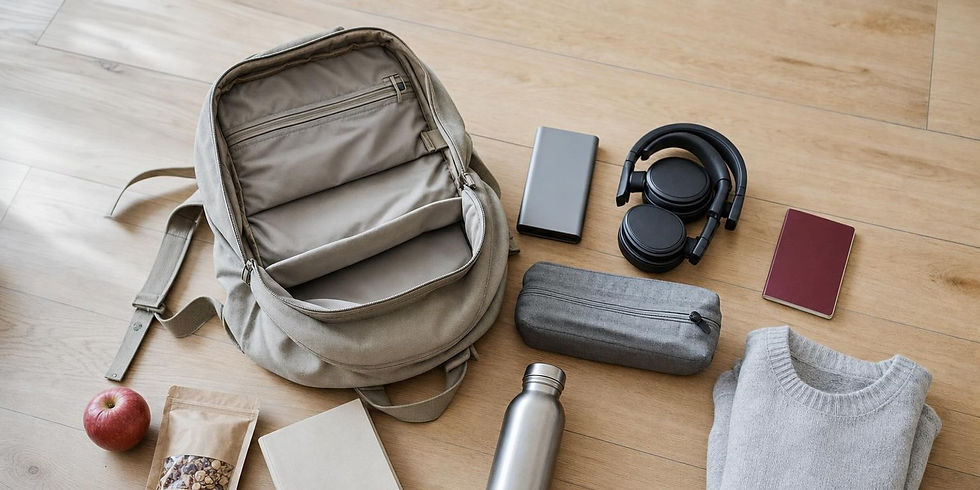
A charged power bank belongs in this same tier, since a dead phone with no charger and no suitcase turns a bad day into a genuinely stressful one. Something like a power bank with USB-C output covers a phone and a set of earbuds through a long delay; if you are not sure which size actually makes sense for how you travel, our power bank sizing guide breaks down the math. Everything in this section should already live in your personal item, not the overhead bin bag, since that is the one you can reach if the flight gets rough or the gate agent asks you to gate-check the bigger bag.
Build a snack plan, because the meal service will not match your day
Airlines schedule meals around the flight, not around your body clock or your connection. On an 8-hour-plus flight you might eat dinner at what feels like 4 a.m., then land with three hours until your next gate and nothing open. Bring your own food and treat the airline meal as a bonus, not the plan.
Solid snacks clear airport security without trouble: sandwiches, dried fruit, nuts, protein bars, hard cheese. What gets pulled aside is anything spreadable or liquid enough to count as a gel under the 100ml rule, so leave the yogurt and the soft cheese at home and bring the crackers instead. Pack more than you think you need. A snack that goes unused costs nothing; a hungry hour at an unfamiliar gate costs more than it should.
Hydration beyond the 100ml rule
The liquids rule stops you from carrying a full water bottle through security, not from carrying a bottle. Bring an empty one, ideally collapsible so it does not eat space in your bag, and fill it at a water fountain or café once you are through the checkpoint. Cabin air runs drier than almost any climate you will visit, and a full bottle at the gate means you start the flight already ahead instead of waiting for the drinks cart to reach your row twice in 8 hours.
Pack your entertainment backup before you leave the house
Do not test your downloads at the gate. Seatback screens break more often than airlines like to admit, and the free Wi-Fi on a long flight is frequently too slow for streaming, if it is even offered. Download films, a couple of podcasts, offline maps for your arrival city, and one full audiobook the night before you fly, on your home Wi-Fi where a failed download is a five-minute problem instead of a boarding-gate scramble. Bring one paper book or a physical puzzle too. Screens lose their appeal by hour seven of any long-haul economy flight, and having a non-screen option left in reserve genuinely helps.
What happens if your bag gets measured at the gate
On a full flight, gate agents sometimes pull out the sizer and check bags that would normally pass without a second look. If yours does not fit, you will be asked to gate-check it, often for the standard checked-bag fee. Before you hand it over, open it and pull out anything from the priority list above: medication, chargers, your power bank, valuables. Once a bag leaves your hands at the gate, it travels in the hold for the rest of the trip, and lithium batteries are not allowed to go with it. Keep those items on your body or in your personal item from the start of the trip, so a gate-check never turns into an emergency.
Pack the carry-on for the version of the trip where the suitcase does not arrive on time. Medication, a spare change of clothes and your chargers go in first, snacks and a refillable bottle come next, and your entertainment should already be downloaded before you leave home. None of it takes up much room. All of it is the difference between a rough travel day and one you barely remember by next week.
As an Amazon Associate, ThingsToPack earns from qualifying purchases made through some links in this article.


Comments