How to Survive a Long-Haul Flight in Economy

Somewhere around hour seven, every long-haul flight turns into the same movie: dry eyes, a stiff neck, and a stranger's elbow settling into your ribs. You cannot make an economy seat bigger. You can make the twelve hours in it dramatically easier, and most of that work happens before you board.

Choose your seat like it decides the flight
It does. The aisle-versus-window question has an honest answer, and it depends on one thing: do you plan to sleep? The window gives you a wall to lean on and control of the blind, but you climb over two people every time you need the toilet. The aisle gives you freedom and an extra inch of elbow room, at the price of being bumped by every cart and every passenger walking past.
For flights over ten hours, sleepers should take the window and everyone else the aisle. The middle seat is the consolation prize; if you are traveling as a pair, book window and aisle and enjoy the decent odds that the middle stays empty.
Location matters as much as letter. Rows next to the galley get light, noise and clattering trolleys all night. Rows next to the toilets get queues, smells and a door that thuds every ninety seconds. Check the seat map when you book and put at least three rows between you and both.
Dress for a twelve-hour temperature lottery
Cabins swing from stuffy at boarding to fridge-cold at cruising altitude, and you have no say in it. Layers solve this: a t-shirt, a warm long-sleeve, and a hoodie or big scarf that doubles as a blanket. Choose trousers with real stretch. Jeans that feel fine standing up become a slow punishment by hour five.
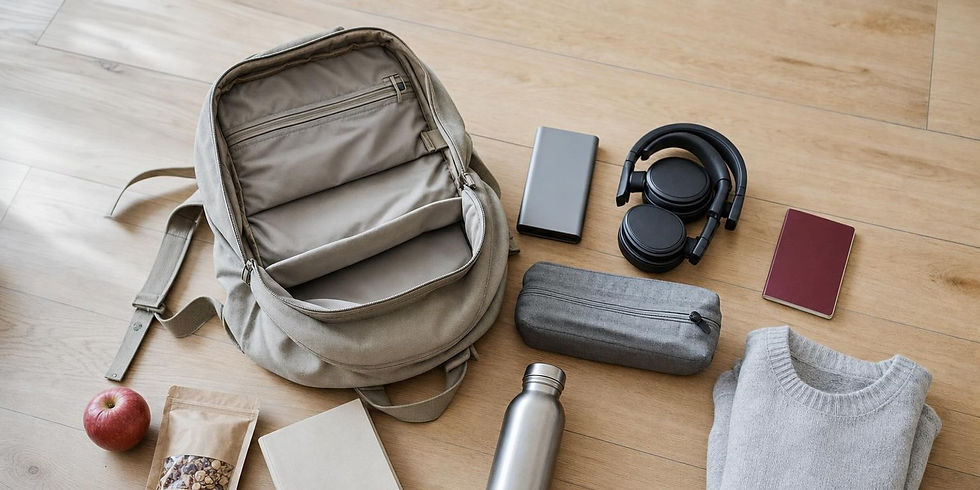
Two small upgrades earn their space. Compression socks keep your ankles from swelling into balloons and make the walk-around habit easier on your legs. And a fresh pair of normal socks, stashed in your under-seat bag, feels absurdly good at hour nine. What else belongs within reach of your seat? Our guide to packing your personal item covers the full list.
Sleep on the destination's clock, not your own
Before you board, decide what time it is. Not at home: at your destination. If it is night there, your job is to sleep as soon as the meal service ends. If it is daytime there, stay awake, even when the cabin lights drop and everyone around you nods off. This one decision does more against jet lag than anything you can buy.
Then make sleep physically possible. Eye mask, earplugs or noise-cancelling headphones, seatbelt buckled visibly over your blanket so the crew never wakes you to check it. Your neck needs support too, because the headrest alone lets your chin drop and jolts you awake. Something like a memory foam travel pillow (paid link) holds your head in place against the window or the seat back; the inflatable ones pack smaller but support less.
About the nightcap: alcohol makes you drowsy, then quietly ruins the sleep it started. You doze off fast and wake at hour three, dehydrated, with the rest of the flight still ahead. One glass with dinner if you enjoy it, then stop.
Eat and drink like the air is desert-dry
Because it is. Cabin humidity sits far below what your body considers normal, and dehydration is behind half of what people call jet lag: the headache, the fatigue, the sandpaper eyes. The working rule is simple. Drink a cup of water roughly every hour you are awake, and refill your own bottle at the galley instead of waiting for the tiny cups on the cart.
Food is the other half. The heavy option on the meal tray, plus a dessert, plus cheese and crackers, sits in your stomach while you try to sleep in a chair. Eat light, skip the second bread roll, and pack a couple of your own snacks so hunger never forces a bad decision. Go easy on coffee after the meal if sleep is the plan.
Move every two hours, no exceptions
Sitting motionless for twelve hours is the single unhealthiest part of flying. Set a loose rule: every two waking hours, stand up, walk to the back galley, and stretch for two minutes. Calves, hips, shoulders. Nobody on a night flight thinks you look strange. Half the cabin is doing the same shuffle.
Between walks, work from the seat: ankle circles, ten per direction. Heel raises with your feet flat on the floor. Shoulder rolls, and a gentle neck stretch to each side. These take ninety seconds, keep the blood moving through your legs, and are exactly what compression socks are quietly helping with anyway.
Plan your boredom before the airport
Assume the seatback screen is broken and the Wi-Fi does not work. Sometimes both are true. Download everything at home: films, a series, playlists, podcasts, offline maps for arrival, and one long audiobook for when your eyes are too tired to read. Bring one paper option too, a book or puzzle, because screens get old around hour eight.
The trick is variety, not volume. Two films, a few podcast episodes, a book chapter, a nap: rotating formats makes time move. It is the same principle that saves you during a stopover, and our guide on what to do during a long airport layover runs on it.
The unwritten rules of a shared row
Etiquette is comfort management for twelve strangers per row. The basics:
Recline slowly, and sit up for meals. You are entitled to the recline; the person behind you is entitled to not have a laptop slammed shut.
Middle seat gets both armrests. Aisle and window each have an escape direction. This rule is old, fair, and not up for debate.
Window controls the blind. On night-into-day routes, keep it down while the cabin sleeps.
Step over sleeping neighbors rather than waking them, and use headphones for absolutely everything with sound.
Use the last hour to land as a human
About ninety minutes out, the lights come on and breakfast appears. This is your reset window. Take your toiletry pouch to the toilet before the pre-landing queue forms: brush your teeth, wash your face, put in fresh contacts or swap the socks. Drink another cup of water, do one last stretch, and repack your bag so passport and phone sit on top.
You will step off the plane into immigration lines and baggage claim, and doing that fresh instead of crumpled changes the whole arrival. The other end of the journey deserves the same preparation as the flight; our guide to stress-free airport travel covers it from check-in to exit.
Before your next long haul, do three things: pick the seat deliberately, set your watch to destination time at the gate, and pack the small bag so everything you need at hour seven is within reach. The flight will still be twelve hours. It just will not feel like a sentence.
As an Amazon Associate, ThingsToPack earns from qualifying purchases made through some links in this article.


Comments