Can You Travel with Just a Personal Item?

You are standing at the gate in Bergamo or Memphis, watching another passenger get pulled aside because their backpack will not fit the sizing frame. Behind you, someone just paid at the counter for a bag they assumed was included. The traveler with nothing but a small pack under one arm walks past both scenes without slowing down. That is the appeal of personal-item-only travel. Whether it works for your next trip depends on where you are going and for how long.

The honest answer first
Personal-item-only travel works well for short trips to warm places where you need few clothes and almost no gear. Three or four days in Lisbon in July, a long weekend in Austin, a work trip with one meeting and one dinner: all genuinely doable, and comfortable if you pack with a plan.
Add cold weather, a laptop plus its accessories, workout clothes, or more than four or five days, and the math turns against you fast. No packing trick fixes a bag that is simply too small for what the trip actually requires. Past a certain point, you are not optimizing anymore. You are just uncomfortable.
What you are actually saving
The saving is real, and it compounds if you fly often. On Ryanair and Wizz Air, every fare, including the cheapest one, includes a free personal item capped around 40 x 30 x 20 cm, as long as it fits fully under the seat in front of you. The larger bag that goes in the overhead bin is a separate paid extra, not a given. Spirit and Frontier run a similar unbundled model in the US, where the carry-on fee is charged on top of the base fare rather than folded into it.
Fly several trips a year on airlines built this way, and skipping that paid bag every single time adds up to real money over a year, not pocket change. If you fly once every August, the saving is nice but small. If you fly monthly for work or as a digital nomad, it is worth restructuring how you pack.
Where compression hits a wall
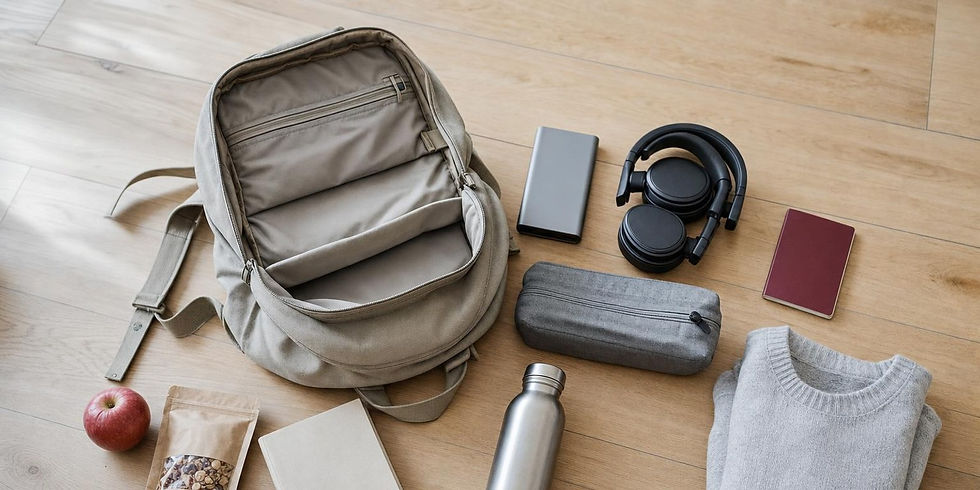
Compression packing cubes squeeze the air out of soft items like clothing, and that genuinely helps. What they cannot do is shrink a laptop, a pair of shoes, or a rain jacket. Once your bag holds electronics, documents, toiletries, and the day's outfit, whatever space is left for the rest of the trip's clothing is small. For the base contents that have to be in there regardless of trip length, our under-seat bag essentials guide covers what earns its spot and what does not.
Even a well-designed underseat travel backpack built specifically for this format only holds so much before you are wearing your jacket instead of packing it. Past three or four days, most people hit that wall no matter how well they roll their shirts. At that point the honest move is accepting a slightly larger bag, not buying another gadget that promises to make volume disappear. If that is where you land, how to choose a carry-on backpack picks up exactly there.
How long can you realistically stretch it
For most people, two to four days in a warm climate is the practical ceiling for personal-item-only travel. Beyond that you are doing laundry in a hotel sink or repeating outfits in photos, which some travelers do not mind and others hate.
Disciplined capsule-wardrobe packers, the kind who plan five interchangeable tops against two bottoms and one pair of shoes, sometimes stretch this to a week or longer. That takes real planning before the trip, not improvising at the closet the night before. For most casual travelers, though, day five is where the personal item stops being a clever trick and starts being a genuine limitation.
Who benefits most
The travelers who get the most out of this are not minimalists chasing a lifestyle. They are people who dread the baggage belt: the ones who have watched their suitcase not appear, or who simply refuse to burn twenty minutes standing around after landing. Skip checked luggage entirely and that risk disappears along with the wait. For a fuller picture of when carrying everything on beats checking a bag, and when it does not, see carry-on versus checked luggage.
Frequent short-haul flyers on budget carriers are the other clear winners, since the fee they dodge repeats every single flight. If neither describes your travel pattern, the savings shrink and the packing compromise stops being worth it.
Try it first on a trip built for it: three days, warm weather, one meeting or one beach. If you land comfortable and nothing got left behind, you have your answer for longer trips too. If you spent the flight sitting on your bag to zip it, pack a real carry-on next time and skip the argument.
As an Amazon Associate, ThingsToPack earns from qualifying purchases made through some links in this article.


Comments