Power Banks on Planes: The Rules Airlines Actually Enforce

There is a specific bin at every airport security checkpoint, and it is full of power banks. Not knives, not oversized shampoo: power banks. People lose them because the rules feel fuzzy, printed in units nobody uses, enforced differently at every gate. The rules are actually simple once someone translates them. So here they are, translated.
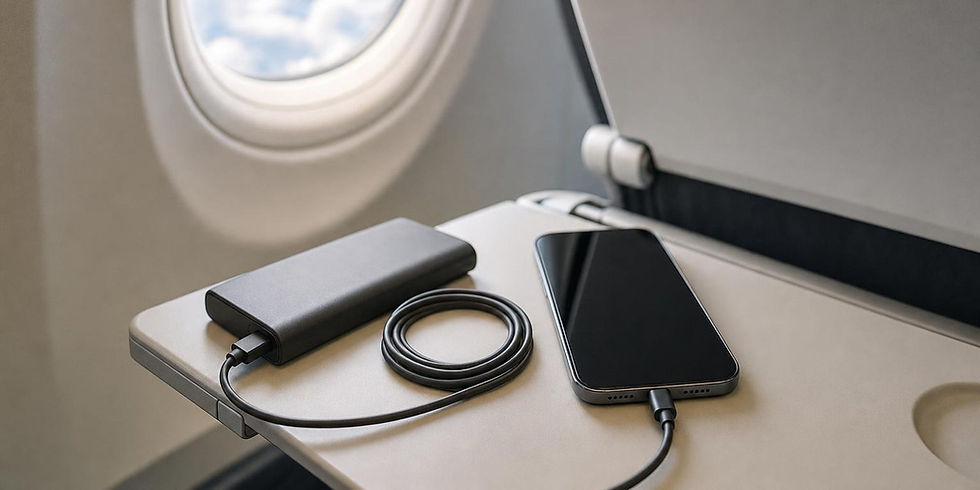
Can a power bank go in checked luggage?
No. Never, on any airline, anywhere. This is the one rule with zero wiggle room.
Power banks are lithium batteries, and a damaged or faulty lithium cell can catch fire. In the cabin, a crew member grabs an extinguisher and the story ends there. In the cargo hold, nobody is watching. That is why every airline bans spare batteries from checked bags, and why check-in agents ask about them.
So the power bank rides with you, in your carry-on or in your personal item under the seat. Same goes for spare camera batteries and anything else with a lithium cell that is not built into a device.
How big is too big?
Airlines measure battery size in watt-hours (Wh), and the line that matters sits at 100Wh:
Up to 100Wh: allowed in the cabin on essentially every airline, no questions asked
100 to 160Wh: allowed only with airline approval, and usually capped at two per passenger
Over 160Wh: banned from passenger flights entirely
Most power banks sold for travel sit comfortably under 100Wh, which is exactly why manufacturers build them that way. If yours is bigger, contact the airline before you fly, not at the gate. Approval at the counter is a coin flip you do not want.
How do I convert mAh to Wh?
Here is the annoying part: power banks advertise capacity in mAh, but airlines regulate in Wh. The conversion is one line of math:
mAh x 3.7V / 1000 = Wh
The 3.7 is the standard voltage of lithium cells. Two numbers worth memorizing:
20,000mAh ≈ 74Wh. Fine on basically any airline. This is the sweet spot for travel, and a standard 20,000mAh USB-C power bank (paid link) charges a phone three to four times.
27,000mAh ≈ 100Wh. That is the line itself. Anything under this flies freely; anything over needs permission.
Most decent power banks print the Wh figure right on the casing, next to the mAh number. If it is there, you never have to do the math. Which brings us to the next problem.
What if the label has worn off?
Then you have a problem. Security and gate staff cannot approve what they cannot read, and an unlabeled power bank is the single most likely one to get confiscated. Brand does not matter. Price does not matter. The printed Wh rating is the only thing anyone checks.
Two things help. First, if the print is fading, photograph the label while it is still legible and keep the photo on your phone. It is not a guarantee, but it has talked more than one power bank through a checkpoint. Second, if the label is already gone, treat that bank as retired for flying. Buy one with clear, durable printing and save the old one for home use.
Can I use my power bank during the flight?
Increasingly, that depends on the airline. After a series of in-cabin battery incidents, several airlines, most of them Asian carriers, tightened the rules in ways that surprise travelers:
Some ban using or charging power banks during the flight altogether
Some require the power bank to stay visible, in the seat pocket or on your lap, not zipped into a bag
A common new rule: nothing charging inside the overhead bin, where a hot battery would go unnoticed
None of this is universal, and the details shift. Listen to the safety briefing and check the airline's site if you are flying a carrier you do not know. The practical workaround is simple anyway: charge everything fully before you fly, and treat the power bank as a backup rather than your primary plan.
What about gate-checked bags?
This is the trap that catches prepared people. You did everything right, power bank in the carry-on, and then the flight is full and the gate agent checks your carry-on into the hold. The moment that bag leaves your hands, it is checked luggage, and the no-batteries rule applies.
So before you hand the bag over: open it, take the power bank out, and keep it on you. Gate agents are supposed to remind you. They do not always. Building a small buffer into your airport routine gives you time for exactly this kind of shuffle; our guide to stress-free airport travel covers the rest of that routine.
Before your next trip, flip your power bank over and find the Wh number. If it reads under 100, photograph the label and pack it in your cabin bag. That is the entire checklist, and it beats donating a perfectly good battery to the security bin.
As an Amazon Associate, ThingsToPack earns from qualifying purchases made through some links in this article.


Comments