4 Reasons Your Next Travel Charger Should Be GaN

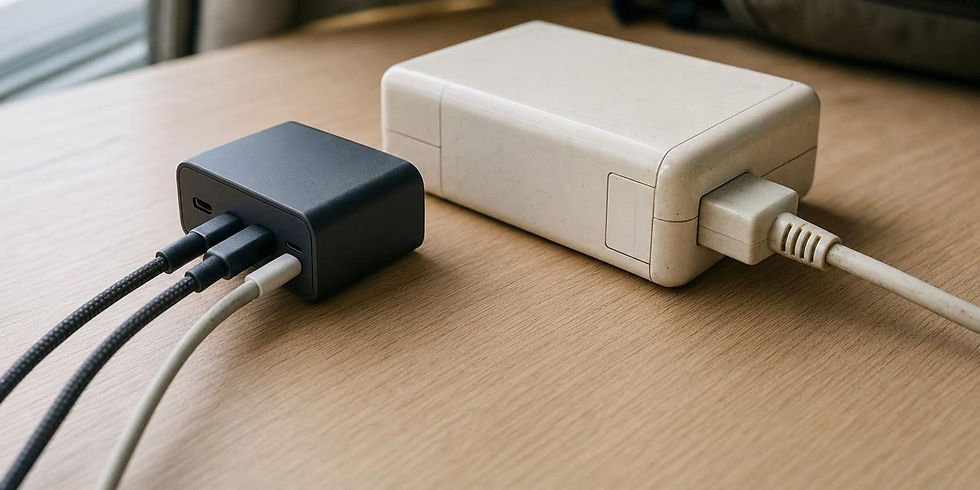
Your current charger is a hockey-puck-shaped brick you've carried for years, with a permanent dent from getting crushed under everything else in the bag. It runs warm enough to notice through the fabric after an hour on the plug. And because it only has one output, you're still packing a second and third charger for your phone and tablet. None of that is necessary anymore.
The Chip Inside Actually Changed
Every charger converts wall power to the DC your devices need by switching current rapidly, and the chip doing that switching used to always be silicon. Silicon has a ceiling: it typically switches at a few hundred kilohertz, and every switch bleeds a little energy as heat. Gallium nitride chips switch at several megahertz, sometimes tens of megahertz, with far less loss per cycle.
That translates into real numbers. Silicon chargers usually convert somewhere around 85 to 88 percent of wall power into actual charging power. GaN chargers regularly land at 90 to 95 percent. The missing few percent in a silicon charger becomes heat, which is why it needs a bulky heat sink and larger internal components. Less wasted heat means smaller parts, which is the actual engineering reason GaN chargers run 30 to 50 percent smaller than a silicon charger of equal wattage. It's not clever styling. It's physics letting the parts shrink.
One Charger Can Actually Run Several Devices at Once
Cheap multi-port chargers, the kind you've probably owned, split a fixed pool of watts across whatever's plugged in. One phone charges fast. Add a laptop and both slow down, sometimes badly, because the charger has a single shared power budget and no real way to divide it fairly.
A decent GaN charger with two or three ports works differently. It negotiates power on each port independently, so your laptop can pull close to its full wattage while your phone pulls close to its full wattage at the same time, instead of both settling for whatever's left over. If you're comparing options, check the multi-port GaN chargers by their printed wattage breakdown per port combination, not just the total number on the box. That number is where the real difference between a good unit and a mediocre one shows up.
It Replaces the Two or Three Chargers You're Still Packing
This is the reason that actually matters if you travel often: one GaN charger with two or three ports replaces the separate laptop brick, phone charger, and tablet charger you've packed on every trip for years. A single 65 to 100 watt GaN unit weighs somewhere around 100 to 150 grams, roughly what one old laptop brick alone weighed, and it does the job of two or three bricks combined. Pair it with a solid adapter, covered in our guide to choosing a universal travel adapter, and you've solved the two heaviest items in your electronics kit. For the fuller setup built around one of these chargers, see our guide to the digital nomad power kit.
It Doesn't Cook in Your Bag for Six Hours
A charger running hot is a minor annoyance on a desk near an open window. It's a different problem crammed into a daypack against your back on a long bus ride, or left plugged in under a coworking desk for a full workday. Silicon chargers under sustained load can get warm enough to be uncomfortable to touch, and that heat cycling wears down internal components faster over months of travel. GaN chargers stay noticeably cooler under the same load, which means less stress on the parts and a charger that's less likely to degrade the way an old, overworked brick eventually does.
Not Every "GaN" Label Means the Same Thing
Here's the catch worth knowing before you buy. A "GaN" sticker on the box doesn't guarantee you get the full benefit. Some cheaper chargers pair a single small GaN chip with otherwise ordinary internals, closer to a hybrid than a true GaN design, and the size and efficiency gains end up smaller than advertised. Skip the label and check two numbers instead: total wattage, and per-port wattage when multiple devices are plugged in simultaneously. A charger advertising "100W GaN" that drops to 18 watts per port the moment two devices share it isn't doing much for you. The same logic applies if you're shopping for a new power bank at the same time; our guide on what size power bank you actually need for travel covers the wattage math there too.
Retiring an old silicon brick isn't just about shaving grams, though it does that too. It's one less charger competing for a socket, one less device slow-charging while another waits its turn, and one less thing running hot against your body for hours at a time. Check the port wattage chart before you buy, not just the GaN sticker, and pack one charger instead of three.
As an Amazon Associate, ThingsToPack earns from qualifying purchases made through some links in this article.


Comments